Savannah

OLYMPUS DIGITAL CAMERA

We arrived in Savannah July 17, a two day trip from Brunswick, GA. That was our first trip without a training captain. It was just Sue and I along with Ethan and Aaron, our 10 and 8 year old grandchildren who were visiting us.

Traveling at 10 knots or less in a boat like ours takes time. We don’t travel more than 8 hours in a day. We like to start at dawn, about 6:30, and travel to about 2:30. The weather in this part of the coastal US has been pretty hot lately, and we like to avoid the thunderstorms that form in the later afternoon. So we split the 110 mile trip (as the intracoastal winds along) from Brunswick into two days.

I always thought the east was more crowded than the west, but it is not crowded at all in the Georgia coastal area. There are no marinas, towns or much of anything else between the two cities, so we anchored out for one night on the way. We really liked anchoring. We were all by ourselves in the middle of nature. I’ll have to write a post just about anchoring later.

The picture above shows one reason we like traveling by boat. It’s taken off the back and shows boats at another marina across the Wilmington river, which is the name given to the part of the intracoastal we are on now. If we were traveling by motorhome we would be in a lot with other motorhomes at the edge of town, or maybe in a Walmart parking lot. Here the Savannah old town is a five minute drive away.

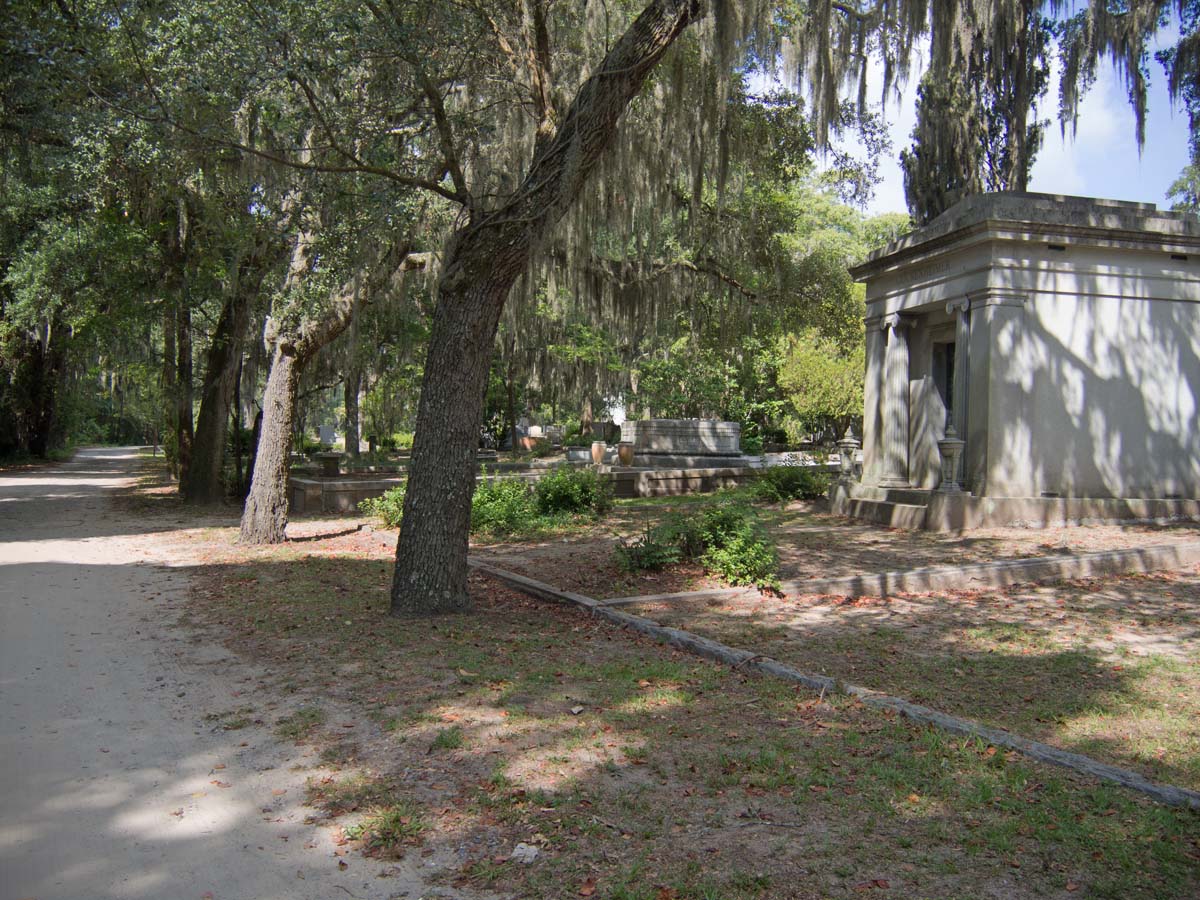
The trees ahead in the above picture are the edge of Bonaventure cemetery. Shortly after we docked I blundered into it when I put down the motorbike, took Ethan and looked for a safe place for a short ride. Later I learned it is in the US Historical Trust. Sue and I have been back twice since then. I have seen a lot of cemeteries around the world but I think this may be the most beautiful. The trees and Spanish moss overhang monuments and obelisks everywhere. This is one of the highlights of Savannah and we would not have noticed it if we were not right by it.
OLYMPUS DIGITAL CAMERA    OLYMPUS DIGITAL CAMERA

We’re having some work done to the boat at the Savannah marina, so we have had plenty of time to see Savannah. We especially like the old town section. The buildings on one side of River Street have been restored and hold a touristy collection of shops and restaurants. The river on the other side has a lot of traffic. Large container ships passed each other right in front of us. I don’t see how they had room to do that. We have seen more than six of the house museums, and the maritime museum is not to be missed if you like models of old ships like we do.
 

Standard

Brunswick at Last

OLYMPUS DIGITAL CAMERA

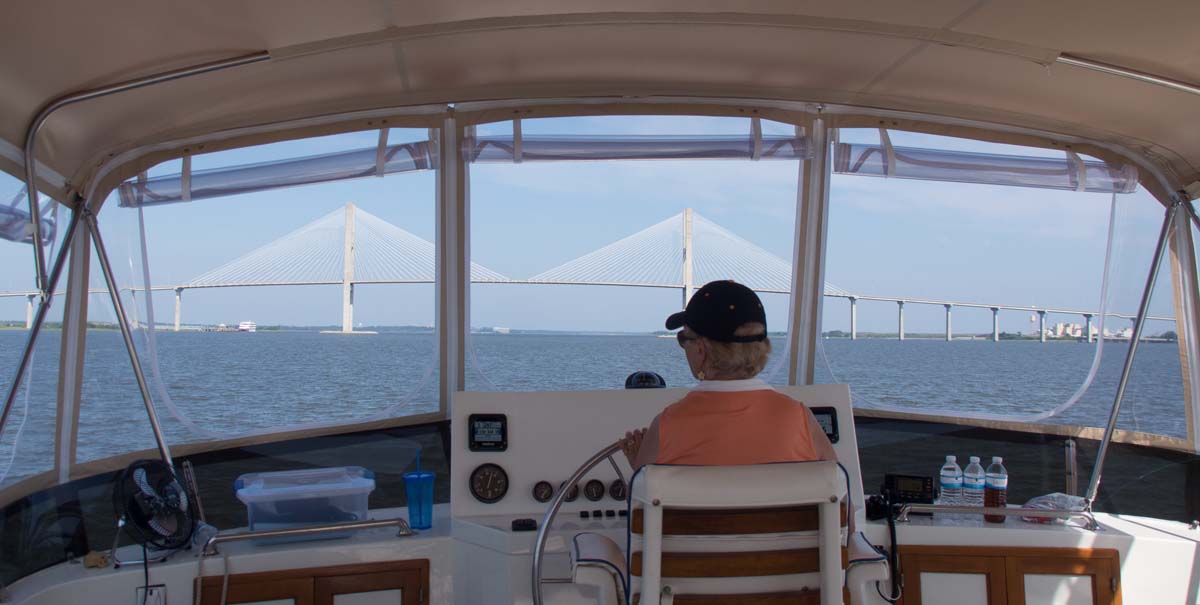
We crossed under this bridge to get to Brunswick Landing marina.

Brunswick GA is the first town of reasonable size with marinas after crossing out of hurricane country and into Georgia from the south. We’re on dock 8 at Brunswick Landing marina. That’s the one near the restroom and showers, which is great since this marina stretches for a mile along the inlet coast. A lot of people stay here this time of year, and we met a number of them, including 4 couples in our DeFever club.

We are the only boat in a back in slip for two, which is great for my docking practice. I don’t have to worry about crashing into the next door neighbor.

Our grandsons have come to visit with us and will stay for over a week. We have seen a number of things with them, including Jekyll Island and its beach that goes on forever and the second church that John Wesley preached in before he went back to England and started the famous revival. We also located a fishing charter captain specializing in fishing trips for kids. Ethan and Aaron both caught a number of sharks, whitefish and rays.

OLYMPUS DIGITAL CAMERA AaronShark

Standard

Our first Locks

OLYMPUS DIGITAL CAMERA

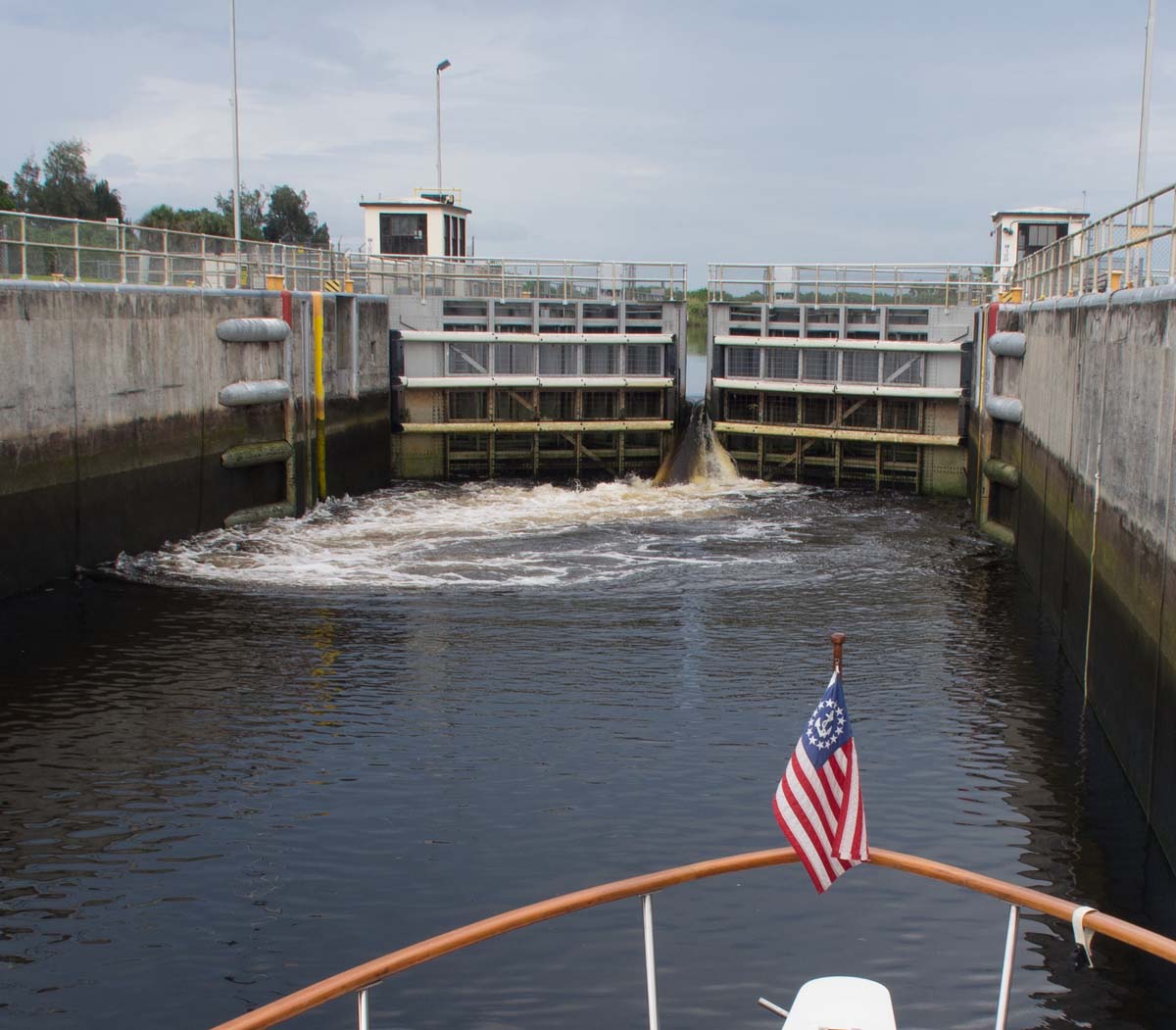
We’re locking upward. That waterfall can be 10 feet or more high, and don’t forget water is entering furiously below the waterline as well.

One place where Captain Bill was needed was locking. The canals connecting Lake Okeechobee with the Florida coasts had three locks to step up to the lake and three more to step back down. It’s best done with one person at the controls and two people handling the lines, one at the bow and one at the stern. I’m hoping Sue and I can work together well enough to eventually do this on our own. Sue will take the bow, while I will pilot into position and then run down to the sundeck to handle stern lines.

It’s important to tie securely to the walls of the locks because of turbulence when the gates open to let water into or out of the lock. This is especially important when locking upward. Water coming at you is more turbulent than when going away. You can prove this with air by standing close in front of a fan in the middle of a room. Now stand the same distance in back of the fan. You’ll feel a lot more in front, where the air is coming toward you.

The turbulence can swing a boat around and crash it into the opposite lock wall or other boats. The front and the back of the boat has to be secured, so it’s a lot easier if there is a deckhand at each end. See a video of the above lock here.

We will probably have only one or two more locks as we navigate the Atlantic intracoastal this year, but we’ll have a lot of them, at least 145, on the loop next year. Maybe by then we will work together on this like a well oiled machine. Even so having deckhands, I mean guests, along when locking can be really nice.

Standard

The Race to Brunswick

x    x

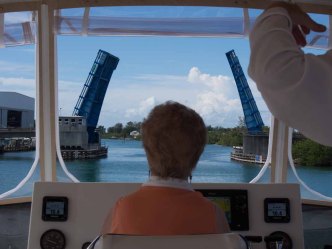
Swing bridges and draw bridges opened for us.

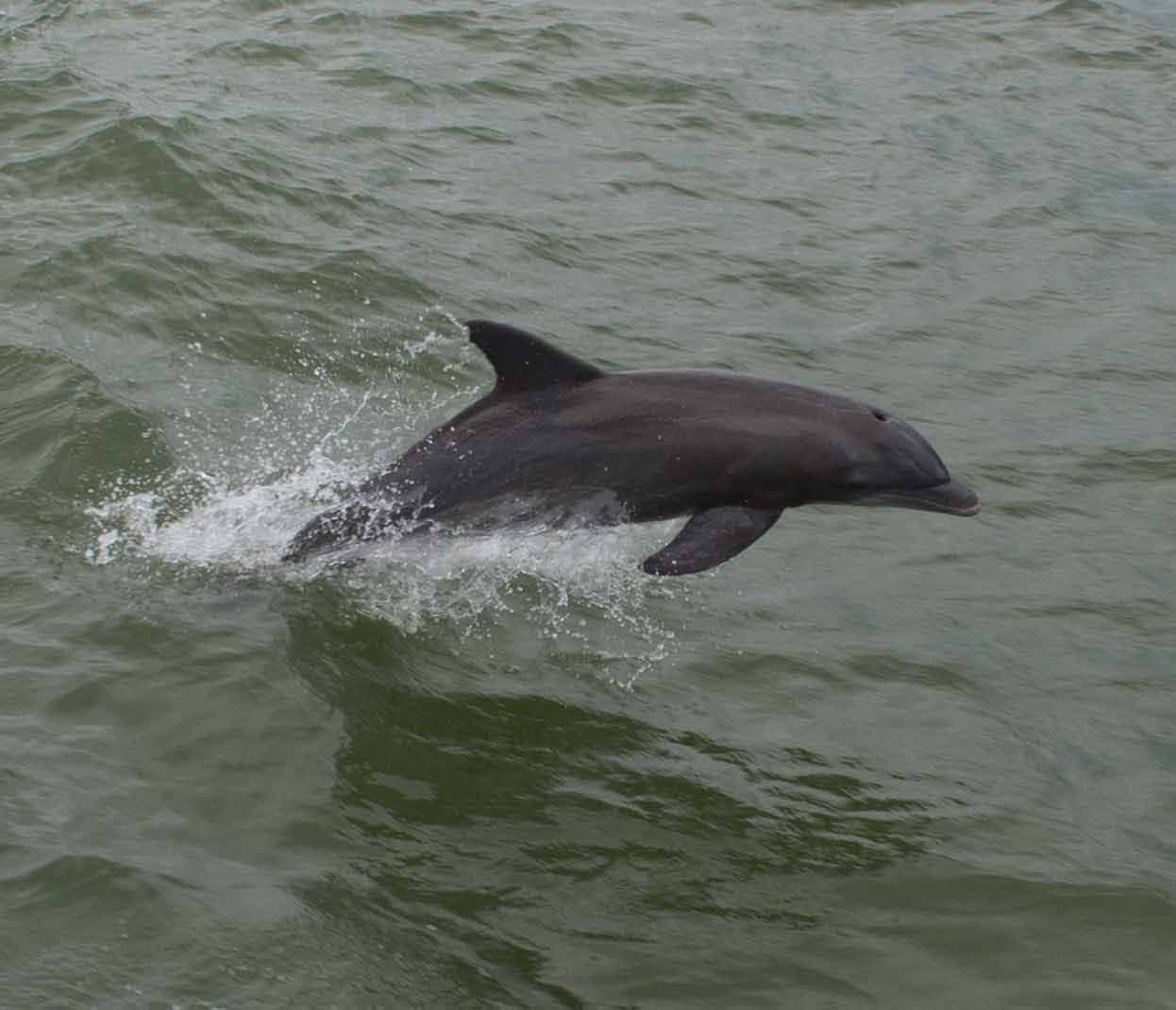
No time to write until now. We are on an anchor ball for the night in a harbor just before the Old Roosevelt bridge near Port St. Lucie, FL. We have reached the east coast! It’s been a great trip so far down to Ft Myers and into the western Okeechobee canal with 3 locks along the way. We stayed overnight in Sarasota, Ft Myers and a marina just before the lake. Today we crossed the lake and the eastern canal with 3 more locks to where we are now. Below is one of the many porpoises we saw and the western canal when we started out as well as the western canal when we started out early today. You can enlarge any picture by touching or clicking on it.

OLYMPUS DIGITAL CAMERA OLYMPUS DIGITAL CAMERA

Our boat underwent an extensive refit just north of Sarasota, FL so we left on our first trip from there. We have to keep on the move each day because we are being chased out of Florida by the tax man and our insurance company. We stop each evening at a different anchorage or marina.

If you buy a boat in Florida you don’t have to pay sales tax for 180 days if the boat is being worked on there. Our refit ended up taking about 6 months, so when it was finally done we had to move quickly. In addition it was already June. Boats with my insurance have to be out of Florida during hurricane season which goes from June 1 to November 1 each year. I was able to get an extension from the insurance company, but they still want us out before the end of June.

Our only boating experience was a 19’ runabout and two personal watercraft that we owned on Lake Coeur d’Alene years ago. Piloting a larger boat on the eastern waterways is different. There are few state or federal requirements to do this as long as we don’t take along paying passengers. If we are stopped some states and Canada ask for a card. The only cards most states issue, including our state of Texas, is one showing you have completed a boat safety course which can be done online. So I took that course and have the card to prove it. It concerned driving, docking and trailering small boats and watercraft.

While the government does not care, it turns out my insurance company is deeply concerned. They required us to hire a professional captain for the first week to show us how to do things. Bill Slattum accompanied us from just north of Sarasota, FL down to Ft Myers, through the Okeechobee canals and lake to Port St Lucie on the east coast where we are now. He’ll stay on as we go up the Florida coast until we cross the border and dock in Brunswick GA.

Bill is great to have along and we would have hired him whether the insurance company required it or not. We have a lot to learn. Bill does not drive much. He watches as we do the work and gives advice as needed.

Standard

Star Gazer

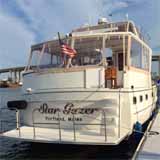
Since our boat is federally registered, it has no license numbers on the bow, and just its name, Star Gazer, on the stern. That, along with its Portland Maine “hailing port”  is its unique name in the Coast Guard registry. We have never been to Maine and don’t plan to go, with or without our boat. The inland city of Austin, Texas, where we do have a home, seemed inappropriate so we picked Portland out of the air. Star Gazer really has no home port. It can be anywhere on the loop, the only requirement is that it be to the north in the summer and to the south in the winter.

We started boat shopping in late 2013. We went to a broker boat show in St Petersburg, FL in December where some of the used power boats for sale are seen from the sun deck roof of our boat in the picture below.  and Sue fell in love with our boat. Since it was fairly old its price was about a tenth of a new one. I did not like the 4’8″ draft since the maximum recommended draft for the loop is 5′, but the stand up engine room reached through a door instead of by pulling up hatches in the salon floor makes up for it. We’ll just have to be careful and watch our depth. Sue especially liked the kitchen toward the back of the salon on the same level – it’s called “galley up”. She can see out the large salon windows while working there.

StPeteShow     OrigGalley

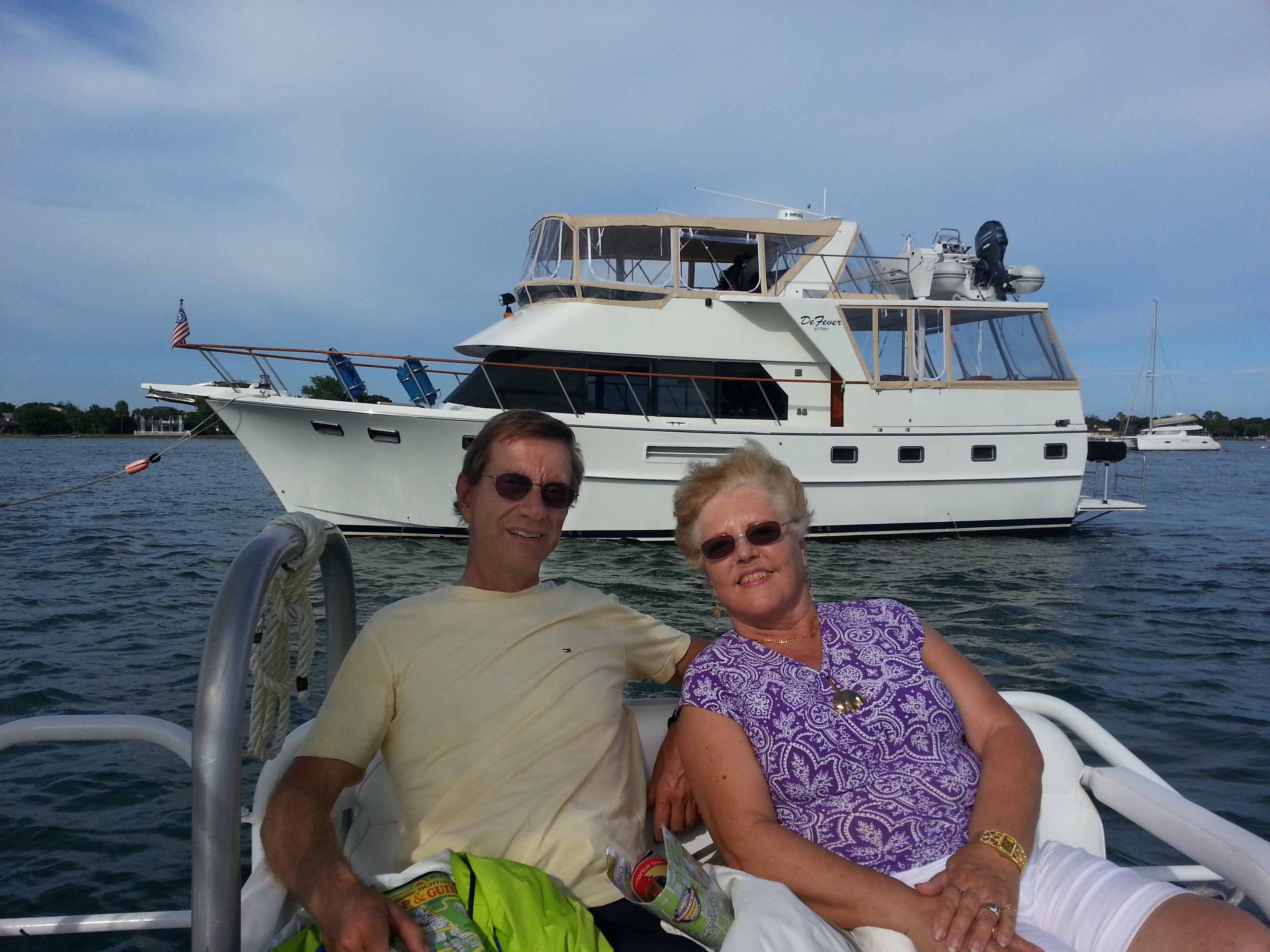
Star Gazer is a DeFever, which is a trawler boat type. Most trawlers have length in the 40 or 50 foot range. Eight knots is a common cruising speed for one. They have displacement instead of planing hulls, so they can travel efficiently (for a boat) at their cruising speed. Trawlers have a fairly wide beam for their length. Our 47 is 16 feet wide. This allows a walkway outside of the cabin all around the boat, which is handy when we are going through locks and need to get from one end to the other to tie up. There are 145 locks the way we plan to travel the great loop.

Cabin space is generous on a trawler. To board our boat you normally would step from a floating dock to our swim platform in the back. Go up 5 steps (we have no ladders – important as we get older) to the back sundeck. From here you can go forward and 5 more steps up to the fly bridge, or through a door and 4 steps down the salon beneath it. From the salon you could go back and 5 steps down to the area under the sundeck which has our master bedroom, a guest bedroom which we use as an office and two bathrooms which share a tub/shower. The closet in the office holds a washer and dryer. Forward from the salon and 5 steps down is a small hallway leading forward to the front bedroom and bathroom. Back from this hallway is a door to the engine room which is under the salon. Click  here to see the fly bridge

While our boat’s top speed is about 16 knots, that uses barrels of fuel and we never go that fast. We sometimes go 10 knots, where we use about a gallon per hour, or about a mile per gallon. At that speed we create a pretty fierce wake: the bow is up and the stern is down and we are essentially pushing uphill. Dropping to 6 ½ knots allows us to glide along with no wake at all. The maximum amount of energy from the engines is put into forward motion. So going slower saves a boat load of fuel. There’s nothing like effortlessly gliding along at 6 knots early in the morning on a glassy smooth waterway.

Sometimes it’s like a crime to pump it up to 10 knots and thrash through the water, but other times it’s great. We call 10 knots “porpoise speed” because they love to come and surf ahead of our wake. As many as 4 can be on one side. I wonder if it affects our mileage to be dragging these guys along with us. Click here and here to see them.

Standard

Discovering the Great Loop

CardPicBlog

We start this blog as a diary of our travels in our boat. It’s for us to remember where we have been, for a few relatives and friends, and for anyone who’s curious about the Great Loop. Some of our readers have travelled extensively in the past and now have to remain more fixed. They want to follow along and see what happens. Others may join us for parts of our trip. Nearly all our family and friends are from the western US, but anyone out there is welcome to follow along. I’ll also describe things about our boat and its operation. I’m just learning all this now, and I’ll tell you what I learn when I learn it.

We find the eastern coastal area to be very different from that of the west. The Atlantic is not as rough, cold, or wild as the Pacific, but the real difference is the intracoastal waterway, which does not exist in the west except for the Alaskan inside passage. Going from port to port in the western US means an open water trip. We do not wish to prove ourselves against the elements. In the east we can be off for a few nights at a remote anchorage, but then be back at a marina in the historic part of town and enjoy the traditional old east and south.

Right now we are sitting at a marina in Savannah GA. We’re new to boating and have been at it 2 months. At the start of this (2014) year we bought a 1987 DeFever 47 POC (Performance Offshore Cruiser) and started a major refit. At the end of May we came to the boat and started on our way. What we really got the boat for is the Great Loop. Just go to “greatloop.org” to learn more about this.

This year we started a little late and did not know how to pilot the boat, so we decided to wait until next year for the loop and just meander from Florida up the Atlantic intracoastal waterway. We’ll go back to Florida when winter comes and start the loop in March next year.

This started in July 2013 when Sue was in India for a few weeks. I discovered the “Great Loop” on the internet. This is a 6000 mile trip, nearly all in protected waterways that covers much of the US east of the Mississippi (again, refer to greatloop.org). I grew up in North Idaho, and Sue in Santa Clara valley. We have travelled many places in the world, but never in the eastern US. This seemed like the perfect way to see it.

What the East has over the west is tradition. I remember that much of my early education in Idaho was about what happened here in the East and old South. The revolutionary and civil wars, Erie canal, rise of the industrial US, etc. The oldest parts of the US, before good roads and the railroad, started on the waterways. A boat would be a great way to see them. Taking branches off the “main” loop you can see more. There are nearly 30,000 miles of accessible protected waterways in the US, all without ever taking the boat out of the water.

I’m writing several of these posts on August 30, 2014. I will back date this one to the start of our trip, and do the same for a few more that follow, so they will correspond to their content. Once I am caught up to where we are now, in Savannah, GA, things will post on the proper day.

In addition to this blog, there is more information about Jack and Sue:

Our adventures in Thailand and Myanmar are recorded in another blog: opportunityfoundation.org/ofblog/

Memior/Biography for us on Amazon. Search for “To Build a Life by Jack Simpson.”

Standard